Friday, February 24, 2017

Thursday, February 23, 2017
it's time to plant onions!
I sowed my first seeds of the season. A tray with several types of onions, leeks, and celeriac. My planting calendar said it was time.
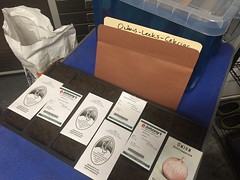
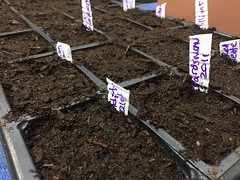
I couldn't find my leftover plant labels from last year, so I cut up a plastic tofu container. I'll get better labels before I need to mark the rows outside.
I'll start up a post soon with a list of the onion varieties I planted. I'll continue fill in this list as I plant more seeds. Next on my planting schedule are cabbages and escarole, but that's not for another two weeks. Until then I'll just watch my onions germinate. (That usually takes 7-10 days.)
I couldn't find my leftover plant labels from last year, so I cut up a plastic tofu container. I'll get better labels before I need to mark the rows outside.
I'll start up a post soon with a list of the onion varieties I planted. I'll continue fill in this list as I plant more seeds. Next on my planting schedule are cabbages and escarole, but that's not for another two weeks. Until then I'll just watch my onions germinate. (That usually takes 7-10 days.)
Wednesday, February 22, 2017
winter walk
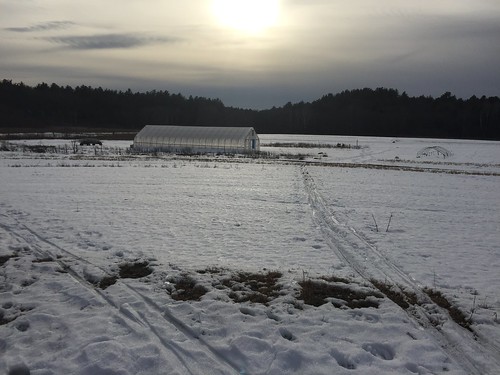
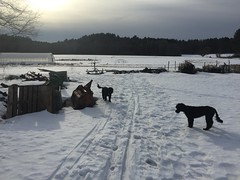
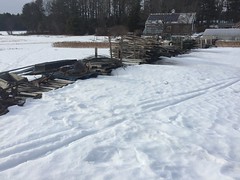
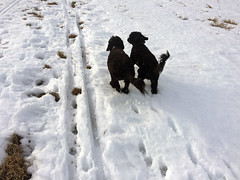
The temperatures have been so nice and warm here the past week. Suzie, Charley, and I had a great walk yesterday. We walked around the fields of a small CSA farm, around the empty greenhouse, piled tomato stakes, and dried stalks of corn and Brussels sprouts. The dogs got all muddy - that's the trade off for warm weather.


Wednesday, February 15, 2017
how do you store your seeds?
How do you store your vegetable seeds packets? The leftover seeds from one garden year that you want to use in future gardens. Or if you don't save any, why not?
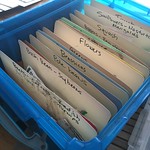
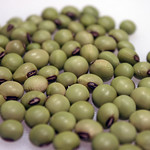

I've been keeping mine in a big plastic box at room temperature, 65-70F (18-21C), and as dry as I can by adding silica gel packets and keeping the top on.
After some reading, I see that the optimum humidity for most vegetable seeds is 20-25%. For legumes it's 44-50%. For temperature, a 10-degree reduction can double the life of my seeds. Optimum storage temperature of most vegetable seeds at home is 41F (5C) or lower, but frozen. It's also important to have a consistent temperature and humidity for storage.
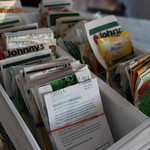

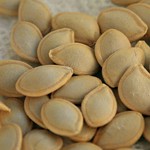
A consistently cooler area I have is the garage. It's 50-60F (10-16C) and 40% humidity. I'll move my storage location out to there, give the beans an open box of their own. I'll keep adding the moisture absorbing packets to the other (closed) box. I'm also curious to check the humidity inside the closed box and see if it's any lower than the surrounding air.
Let me know any thoughts. I never looked into this until a reader commented that she refrigerated her seeds. My seeds last a long time (most about 6 years, some, like tomatoes, 10 years), but I wouldn't mind if they lasted even longer.
Here's an informative site that I found: WFLO Commodity Storage Manual: Vegetable Seeds. (WFLO is the World Food Logistics Org that dedicates itself to the proper handling and storage of perishable products and the development of systems and best practices for the safe, efficient, and reliable movement of food to the people of the world.)
I've been keeping mine in a big plastic box at room temperature, 65-70F (18-21C), and as dry as I can by adding silica gel packets and keeping the top on.
After some reading, I see that the optimum humidity for most vegetable seeds is 20-25%. For legumes it's 44-50%. For temperature, a 10-degree reduction can double the life of my seeds. Optimum storage temperature of most vegetable seeds at home is 41F (5C) or lower, but frozen. It's also important to have a consistent temperature and humidity for storage.
A consistently cooler area I have is the garage. It's 50-60F (10-16C) and 40% humidity. I'll move my storage location out to there, give the beans an open box of their own. I'll keep adding the moisture absorbing packets to the other (closed) box. I'm also curious to check the humidity inside the closed box and see if it's any lower than the surrounding air.
Let me know any thoughts. I never looked into this until a reader commented that she refrigerated her seeds. My seeds last a long time (most about 6 years, some, like tomatoes, 10 years), but I wouldn't mind if they lasted even longer.
Here's an informative site that I found: WFLO Commodity Storage Manual: Vegetable Seeds. (WFLO is the World Food Logistics Org that dedicates itself to the proper handling and storage of perishable products and the development of systems and best practices for the safe, efficient, and reliable movement of food to the people of the world.)
white house vegetables
I heard the new First Lady will keep the White House Vegetable Garden!! "The First Garden". I am so pleased that she values home gardening. I was impressed with the new President's statement to the Japanese Prime Minister:
"Both our countries' histories and cultures are steeped in the nurture and nature of gardening. Having knowledge of different cultures and customs is a wonderful way to learn and to explore. Gardening teaches us the fundamentals in care and the evolution of living things, all while inspiring us to nurture our minds and to relax and strengthen our bodies."Wow. That's great.
Monday, February 13, 2017
organizing seed packets
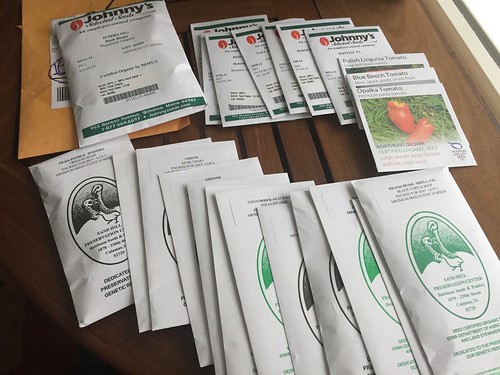
I'm so excited - all the seeds I ordered this year have arrived! Yeah! Almost as fun as planting them is putting them away in my seed organizer.
To store my seeds, I have a plastic box with a lid that holds standard-sized, heavy, 1-inch expanding envelopes. I have 20 of these envelopes. Each I've labelled with a type of vegetable. I have Bush Beans, Pole Beans, Roots (carrots, beets, etc), Flowers, Tomatoes, etc. Each seed packet goes into the appropriate folder.
I love the way this set-up works. It's easy to find my seeds and easy to return them to their spot.
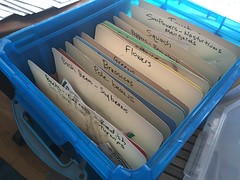
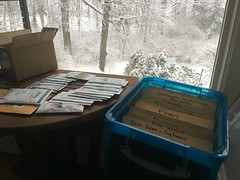
Hannah, who runs the Vegetable Garden at Elm Bank (Wellesley MA) uses this approach and showed it to me. Rather than one box, she has at least ten of them!
I like to show my seed collection to gardeners and make the point that seeds last a long time. Most last at least 5 years. Tomato seeds can remain viable more than 10 years. A few seed types are short-lived, like carrots and onions. But it saves a LOT of money, and is fun(!), to save seeds year to year in an organized system. I enjoy building up a collection with lots of variety.
So now I have my seeds set, I've cleaned up some planting trays, my shelves and lights are up. The next step is getting my hands into dirt and planting. Ahh.... My calendar says to start onions and celeriac next week. But I think starting a week early can't hurt....
To store my seeds, I have a plastic box with a lid that holds standard-sized, heavy, 1-inch expanding envelopes. I have 20 of these envelopes. Each I've labelled with a type of vegetable. I have Bush Beans, Pole Beans, Roots (carrots, beets, etc), Flowers, Tomatoes, etc. Each seed packet goes into the appropriate folder.
I love the way this set-up works. It's easy to find my seeds and easy to return them to their spot.
Hannah, who runs the Vegetable Garden at Elm Bank (Wellesley MA) uses this approach and showed it to me. Rather than one box, she has at least ten of them!
I like to show my seed collection to gardeners and make the point that seeds last a long time. Most last at least 5 years. Tomato seeds can remain viable more than 10 years. A few seed types are short-lived, like carrots and onions. But it saves a LOT of money, and is fun(!), to save seeds year to year in an organized system. I enjoy building up a collection with lots of variety.
So now I have my seeds set, I've cleaned up some planting trays, my shelves and lights are up. The next step is getting my hands into dirt and planting. Ahh.... My calendar says to start onions and celeriac next week. But I think starting a week early can't hurt....
Sunday, February 12, 2017
app updates
I've been working on updates to Skippy's Calendar apps. It's really fun - like imagining a summer garden in the middle of winter! We'll have more plants and more seed sowing information added to both our Flower & Herb app and our Vegetable app. Updates will be available in a week or two (or three) to all purchases made now or later.
Saturday, February 11, 2017
snow shoeing to my garden
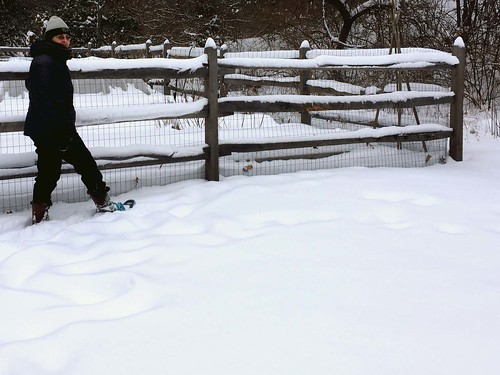
Ten days after my last post and our scenery is whiter. And colder. We had 10 inches of snow Thursday and another 3 or 4 last night. It looks like we're in a snowy pattern with more to come.
Wednesday, February 01, 2017
charley and suzie
We got "snow" last night. One inch. I'm not sure I really call that snow. Nevertheless, Suzie and Charley enjoyed it.
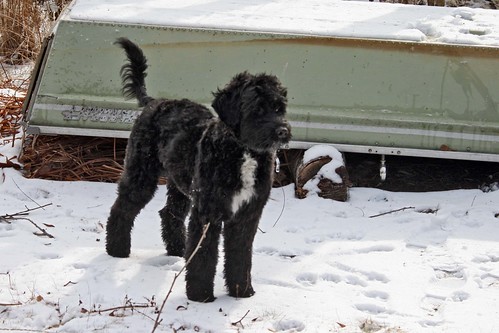






 It's almost impossible to tell who's who these days. Suzi has a fuller tail and Charley has the white chest splash. Suzi does her best to avoid the camera. Charley's a ham.
It's almost impossible to tell who's who these days. Suzi has a fuller tail and Charley has the white chest splash. Suzi does her best to avoid the camera. Charley's a ham.
Monday, January 30, 2017
crop rotation
I recently finished making plans for my vegetable gardens and posted the diagrams. A reader noticed I always plant my butternut squash in one place: on the arbor in the middle of my community garden plot. I like it there. It looks nice and does well.
But the reader asked: Why don't you rotate its location?
Well my view is crop rotation is more often important for farmers growing big fields of vegetables. Growing in a small space is different. It's hard to separate plants in a 500 sq ft space. I've heard and read this, most recently from Victory Garden TV host Roger Swain at a class he gave for my Master Gardener training.
Crop rotation can be done to reduce pathogens or build soil. When thinking about pathogens, many are windbourne or spread by insects, splashing, tools, or the gardener. For these, moving crops a few feet to another bed doesn't help much. There are also crops that don't have many pests in a given area and there's no need to rotate these.
Crop rotation to build soil is a great idea even in a small garden. Squash is a heavy feeder, so I could plant a crop that doesn't like a rich soil, like carrots, in it's place the second year, and then a legume like pole beans to build up the soil the third year, and then in the fourth year go back to squash. Maybe some year I'll try this. Drawbacks are the time it takes to plan out the cycles. Also, here is a tendency for home gardeners to grow many more heavy feeding plants than light feeders or soil builders. And, it's not so hard to get a few shovelfuls of compost and enrich a small patch of soil annually. Anyway I don't rotate for soil building.
I do make sure to rotate crops that are susceptible to soil pathogens in my gardens. These include: 1. Root vegetables, 2. Tomatoes, and 3. Brassicas.
My root vegetables include carrots, parsnips, potatoes, sweet potatoes, onions, garlic, and scallions. (I haven't seen any problems without rotating celeriac and beets.) All alliums (onions, garlic, leek, scallions) need to be considered the same and none should go in the same bed without a break. I rotate them on a three year schedule. The same for tomatoes and brassicas. (My brassicas include broccoli, bok choi, cabbage, and kale.) To make it easier to rotate these, I plant each in their own bed.
Plants I don't rotate are my greens, legumes, herbs, flowers, and squashes. These don't benefit enough from rotating in my small garden. For example, my squash is prone to stem borer, downy mildew, and cucumber beetles. Moving its location won't reduce these. So I add a good pile of compost along my arbor and keep planting the butternuts there.
I'd love to hear how other gardeners handle crop rotation. I'm sure there are lot's of approaches.
But the reader asked: Why don't you rotate its location?
Well my view is crop rotation is more often important for farmers growing big fields of vegetables. Growing in a small space is different. It's hard to separate plants in a 500 sq ft space. I've heard and read this, most recently from Victory Garden TV host Roger Swain at a class he gave for my Master Gardener training.
Crop rotation can be done to reduce pathogens or build soil. When thinking about pathogens, many are windbourne or spread by insects, splashing, tools, or the gardener. For these, moving crops a few feet to another bed doesn't help much. There are also crops that don't have many pests in a given area and there's no need to rotate these.
Crop rotation to build soil is a great idea even in a small garden. Squash is a heavy feeder, so I could plant a crop that doesn't like a rich soil, like carrots, in it's place the second year, and then a legume like pole beans to build up the soil the third year, and then in the fourth year go back to squash. Maybe some year I'll try this. Drawbacks are the time it takes to plan out the cycles. Also, here is a tendency for home gardeners to grow many more heavy feeding plants than light feeders or soil builders. And, it's not so hard to get a few shovelfuls of compost and enrich a small patch of soil annually. Anyway I don't rotate for soil building.
I do make sure to rotate crops that are susceptible to soil pathogens in my gardens. These include: 1. Root vegetables, 2. Tomatoes, and 3. Brassicas.
My root vegetables include carrots, parsnips, potatoes, sweet potatoes, onions, garlic, and scallions. (I haven't seen any problems without rotating celeriac and beets.) All alliums (onions, garlic, leek, scallions) need to be considered the same and none should go in the same bed without a break. I rotate them on a three year schedule. The same for tomatoes and brassicas. (My brassicas include broccoli, bok choi, cabbage, and kale.) To make it easier to rotate these, I plant each in their own bed.
Plants I don't rotate are my greens, legumes, herbs, flowers, and squashes. These don't benefit enough from rotating in my small garden. For example, my squash is prone to stem borer, downy mildew, and cucumber beetles. Moving its location won't reduce these. So I add a good pile of compost along my arbor and keep planting the butternuts there.
I'd love to hear how other gardeners handle crop rotation. I'm sure there are lot's of approaches.
Saturday, January 28, 2017
garden plans
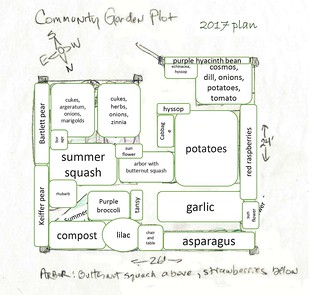
So far, this is what I have for my garden plans. Maybe a draft, but for now it's a start. I'm working on detailed plans for the plantings in the front three beds of my community garden. I want to make them look really nice.

Thursday, January 26, 2017
I'm working on my garden plans today and hope to be done tomorrow. I'm encorporating crop rotation and allocating space for all of the varieties I want to grow. Plus, I want to include lots of flowers that attract beneficial insects and make the gardens beautiful. I want to reduce planting in rows this year and go for more patches and combined plantings.
Wednesday, January 25, 2017
Charley and the chickens
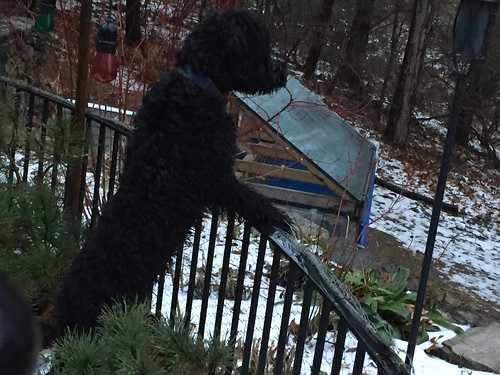
That's my chicken coop behind my inquisitive and always "up-for-the-chase" five month old puppy. Charley caught one of my chickens the other day. The pretty black one I call Penny. Prey instinct kicked in. He chased and caught her, held her for several seconds in his jaw before my husband got there and pulled him off. Penny was scared but fortunately no damage done. Now we don't let Charley out when the chickens are out. It's one or the other. I don't know if this is just a puppy thing. We'll see.
Tuesday, January 24, 2017
a gray day


We've got rain, snow, sleet, and slush today. Dull gray skies. Dreary. The dogs and I walked on muddy, slippery trails. Mud in the car, mud in the house, then "paw baths". A good evening to sit by the fire.
Sunday, January 22, 2017
planting shelves, seeds, and trays
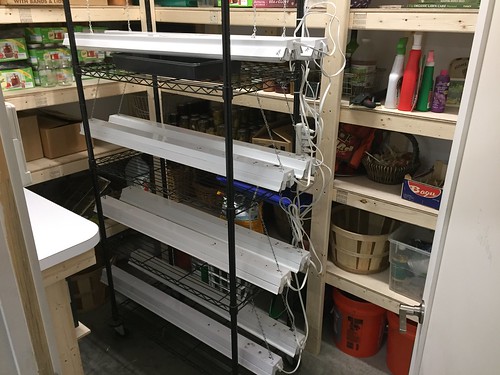
My planting shelves and lights are ready to go! My husband set them up for me. (Thanks Steve!) Rather than putting them in the garage this year, they are in a small pantry where I store my canned goods, books, etc. I can adjust the temperature in here without heating up a large room. Last year they grew very slowly in the 60F garage.
I addition to having the shelves ready, I just sent out my last seed order - the snail mail one to Sand Hill. I'm enjoying seeing my new seeds arrive in the mail. I'll have to show a photo soon of my seed collection as I have a new way of organizing and storing them
Next - I have to get my trays and seed pots cleaned up. 4 WEEKS 'TIL PLANTING - and counting!!
Subscribe to:
Posts (Atom)