Fence
Our plan for the weekend is to get a fence up around my new garden. (Hopefully we can do this in between the rain drops!) For now, we'll put a simple metal fence around half of the beds. I think we'll go with a 5 or 6 ft fence. We have lots of deer, so the main purpose of the fence is to keep them out. We also have raccoons and rabbits that I'd rather not share my vegetables with.
At the community garden I manage, we talk a lot about fencing. Our recommendation there is 4 or 5 foot metal fencing, with wood or metal posts. We like the 1 inch grid, stainless fence with a 12 inch layer of chicken wire or poultry cloth at the bottom, 6 inches dug in and 6 inches above ground. The tall fence protects against human theft, the dug in wire protects against woodchucks and rabbits. We dislike any type of plastic fencing as its not a sustainable option. Plastic is damaged by mowers and gets scattered in the local environment. While a little bit here and there seems innocuous now, plastic is forever. If we let it accumulate, it won't be pretty later. Our main criterion for fencing recommendation is that they are safe for gardeners using the paths. Secondary concerns are esthetic and environmental issues.
With my new home fence, I'll avoid plastic. Metal is more functional and long lasting. Over the long term, it degrades into an innocuous form and is a more sustainable choice.
Soil
We have a fantastic community farm near us and I've discovered they are a source for not only CSA meats, eggs and vegetables, but also for organic aged manure compost. Our plan to fill the new raised beds is to bring in local loam to fill beds within a couple inches of the top, then top off with local compost. I'll vary the amount of compost according to what I plan to plant: 1 inch of compost for root beds, 2 inches in beds for greens, at least 3-4 inches in beds for tomatoes, peppers, squashes, cucumbers and corn. I ordered a loam delivery for midweek, but we'll start bringing in compost this weekend.
Fruit trees
I have specific varieties of fruit trees I'd like to grow: Honey Crisp and Golden Grimes apples, Contender peach and a pie cherry. It will be fun to see what we can find in local nurseries this weekend.
Planting
I have seed potatoes to go in this weekend. Yukon Gold, Kennebec Red, Burbank Russet, and Adironac Blues. Also, I'd like to transplant seedlings of lettuce and other greens. Its time to start seeds indoors for pumpkins and winter squashes.
Saturday, April 26, 2014

Monday, April 21, 2014
pea planting


 Today I planted my peas! The first seeds to go into my new garden.
I brought three wheelbarrows full of loam down to one of my new raised beds. I added two 40 lb bags of composted cow manure, turned it, then raked the surface smooth. I planted two packages of 5 foot tall French snow pea seeds. For each, I cleared a 2 inch deep trench about 5-6 inches wide. Since I haven't planted peas in this soil before, I sprinkled on pea/bean innoculant, scattered the pea seeds, then covered the area. I added some 6 foot tall branches for supports. Our irrigation water isn't on yet, so the seeds will sprout when they get enough moisture.
We are in the process of applying to the Town Conservation Commission for a permit for this vegetable garden site since it's near wetlands: a pond and a seasonal brook. It doesn't seem that there is any problem getting the permit as the garden is all sustainable organic and we are planning work to avoid runoff and mitigate local wildlife habitat issues. But since we do not yet have "go ahead" approval, I am filling and planting one bed at a time. For this first planting, I used a minimum of soil - only 3-4 inches in an 8 inch raised bed. I think approval takes 3 weeks from submission, which will go in next week (hopefully). The submission will include all of the modifications that we plan for the house and yard. One of the modifications to the hose is the addition of a vegetable storage/root cellar that I look forward to filling up with home-grown vegetables.


Thursday, April 17, 2014
planting squash and cukes
Just planted a tray with squash and cucumber seeds.
(in order of my favorites:)
Squash: Waltham butternut, Buttercup Burgess strain, Jarrahdale pumpkin, New England Pie pumpkin, Hubbard blue ballet, and Acorn Honey Bear
Cucumbers: Diva, Tokiwa, Sooyow nishiki, Straight 8, Sumter pickling
Monday, April 07, 2014
leveling my new raised beds
 My raised beds are on a bit of a slope. To level them, my husband secured a 2x4 horizontally to the bottom of each bed at the downhill side. He used three 2x4 stakes on each and left these sticking out a few inches at the bottom. One some beds where the slope was steeper, we left the stakes at the soil surface and filled in below with a layer of brick. For most, the stakes were dug in leaving the horizontal 2x4 resting at soil surface. One or two were on a flatter ground and he dug the whole horizontal board in a bit. We used brick to fill in at the sides. Now all of the beds are pretty much level. Next step - add dirt!


Saturday, April 05, 2014
germination test of old corn seeds
 I'm doing a germination test of my old corn seeds. They were "Packed for 2009" - 6 years old. Any bets on whether they'll sprout?
Friday, April 04, 2014
forced forsythia
 I have always wanted to be able to force forsythia. Our new house has lots of it around to cut. It bloomed within a couple days of bringing it inside. I suppose it won;t be long til its in bloom outside.
Wednesday, April 02, 2014
chickens and eggs
 We are doing some renovations upstairs of our new house where there's a good view of my chicken coop. The construction crew tells me they've seem a big red tailed hawk fly down and perch on my chicken coop a couple of times.
Of all places! Can't he perch on some bird feeder or a random small tree?!! He might as well put in his order for a chicken lunch!
The red tails out here are BIG! I've been impressed. They must be better fed than the ones in more urban Belmont. Stronger and better fed.... and able to carry off large chickens for lunch....
Usually, I let me hens run free an hour or so in the afternoon sun. After this conversation with the construction guys, I only let them out briefly today when I could watch them carefully. The problem was, it was such a nice day and the girls really wanted to run for a while. After 20 min, I started trying to get them back into their coop and it took me a good 20 min. They did NOT want to go.
So, the eggs in the picture above are what the hens lay in about 5 days now. Since all 3 hens are laying, finally, I usually get 6 brown eggs per week from Penny (Black Australorp), 5 blue/green eggs per week from Ginger (Auracana), and 3 giant pink eggs a week from Bertha (Light Brahma). Bertha has just started to lay. So that's 14 egg a week. Plenty for us, and we're giving some away to anyone who leaves a car with open windows on the driveway ;-) Tomorrow I'm planning to make mushroom quiche, and then, Friday for guests, I'll make some deviled eggs of all different sizes.
Tuesday, April 01, 2014
seedlings inside under lights


 I have lots of little seedlings growing. Beets, broccoli, marigolds, lettuce, escarole, endive, eggplants, peppers, tomatoes.... Some I'm on time planting, some ahead of schedule and some behind schedule.
Monday, March 31, 2014
soggy crocus
 Everything is cold and soggy, if not icy this spring. These are some sheltered crocus in my yard - trying their best to bloom.
Our local plant grower is having hard time with the cold weather. She's pulled plants out of the greenhouse and into her heated garage. I heard at Home Depot that all growers in the area are at least 2 weeks behind because of the cold weather.
Well, I'm pulling for the little crocuses. It would be cheery to see some color around here about now.
Saturday, March 29, 2014
the raised bed movie!
Here's another movie of my garden: Time lapse video of raised bed construction. Funny to see us running around and making 8 raised beds in 2 minutes....
eight new raised bed frames
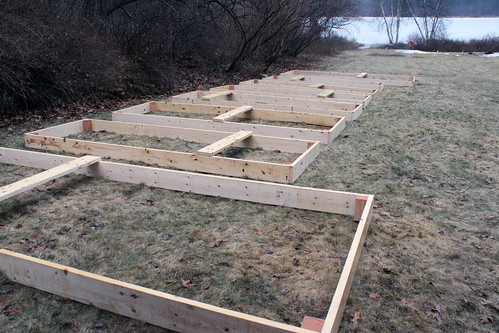
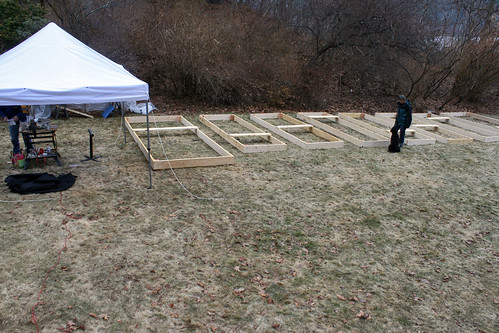 Yesterday my husband and I made eight raised beds for my new garden! Kind of a dreary late March day, but I am so happy seeing the beds all lined up! We made six 4x12 foot beds and two 6x15 foot beds.
To make the six 4x12 beds:
- We started with fifteen 2x8x12's, untreated pine.
- We brought a compound miter saw down to the garden area. (It was raining off an on so we used a canopy to keep it dry.
- To make the 4' edges, four boards were cut in thirds.
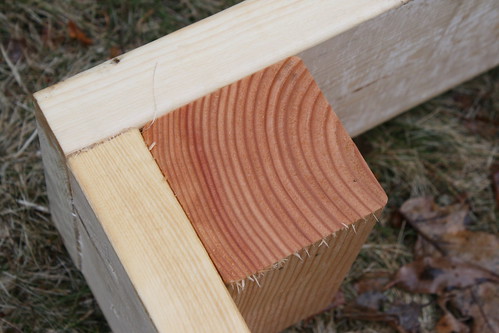
- To make 24 corner brackets, two 4x4x8 untreated fir beams were cut the width of the boards, 7.5 inches.
- We butted up the boards one edge at a time and attached them using wood screws.
- We then placed the 4x4 bracket beam piece in the corner and used self-threading lumber screws to securely attach from both sides.
- Then we placed the beds where we wanted them. We're still looking at the placement and it may take us a few days to get the positioning we want.
- Next steps, we will level the beds with brick at one edge since we are on a bit of a slope. Then we'll secure the beds in place by pounding in wood stakes on the outside of the beds, every 3 feet. Then we'll add DIRT and plant stuff!


Wednesday, March 26, 2014
scoping out sizes of new raised beds
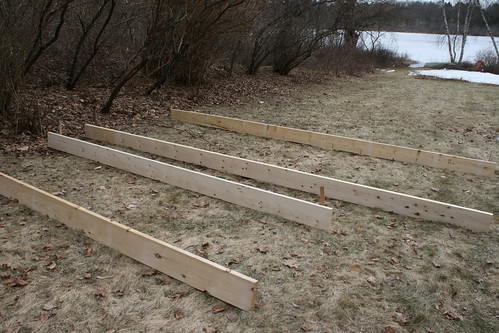 My husband and son carried the wood that will edge my new raised beds down to the site of my new garden. We then laid out a few pieces to see how the beds will look. My plan has six 4x12 foot beds and two 6x15 foot beds.
time lapse video: making Skippy's new garden
I am making a time lapse video of my new vegetable garden. So far, the video only shows us bringing the boards for the raised beds down to the garden area. The boards are 2x8 untreated pine.
We also set out a few boards where the edges of the beds will be, just to see how they look.
Time Lapse Video: Making Skippy's New Garden
I'll extend the video as we create the garden and as the plants grow this year. Tomorrow we plan to make the raised bed frames.
Tuesday, March 25, 2014

Friday, March 14, 2014
6 yr old onion seeds didn't sprout...
How long do seeds last?
I've given up on my 6 year old onion seeds. :-( They didn't sprout this year. Time to throw out the package. I think also last year they also didn't sprout. It may have been the previous year (4 years old) that was the last time they came up. And that year, they took an extra week to come up.
Onions seeds are one of the more short-lived types. Its often recommended you only use them the season they are packaged for. Other short-lived seeds include corn, leek, onion, parsnip, and spinach. Hmm, I haven't bought spinach in ages. Mine have saved very well. But I agree with putting parsnip in this list and I'd add carrots here. I have some 5 year old popcorn seeds I was thinking of using again this year. I'll try a test germination on paper towels to see if there's any life left in them.
Long-lived seeds include beets, all brassicas (broccoli, Brussels sprouts, cauliflower, cabbage, collards, kohlrabi), chicory (endive, escarole, radicchio), cucumber, kale, lettuce, melons, mustard, peppers, radish, rutabaga, sunflower, tomato, and turnip. Long-lived means 5-10 years if kept cool and dry.
Subscribe to:
Posts (Atom)