Showing posts with label storing garden vegetables. Show all posts

Sunday, November 20, 2016

storage of vegetable - and other items, like honey, fruits, etc

IMG_9059

I've been winging it so far in storing my vegetables and honey. But my honey has all crystallized and my potatoes are sprouting.

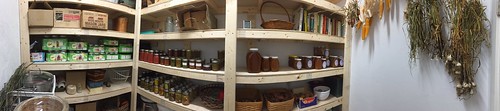
I have a pantry with a temperature system that I can set 60-75ºF. Or I can leave the system off and the temperature will stay about 50ºF since it's on a cement slab. The room also has a dehumidifier. In addition to this pantry, I have a fridge, and a good sized deep freezer. And there are other areas of the house with different temperatures. So, where to store what?

I have a great book on vegetable storage, "Root Cellaring" by Mike and Nancy Bubel. Roger Swain reviewed the basics of vegetable storage in my recent class. And, I've had advice from my readers on a recent post about my vegetable and honey storage.

So, I've looked up winter storage conditions for all the crops I grow. I've figured out where in my house (or garden) I should be able to store them with conditions at least close to optimal.

1- Leave in the ground until just before it freezes Parsnips, carrots, turnips, winter radishes, celeriac

2- In garden under winter tunnel
Greens: escarole, spinach, lettuce, mustard greens

3- Frozen
> In deep freezer
Pesto's, dried fruits, roasted peppers, pears in syrup or plain, raspberries

4- Cool and very moist, 32-40ºF, 90-95% humidity
> In plastic bags in the refrigerator
Carrots, beets, parsnips, Chinese cabbage, celeriac, leeks, broccoli (short term), horse radish

5- Cool and moist, 32-40ºF, 80-90% humidity
> In mesh bags or baskets in the refrigerator
Potatoes, cabbage, apples, pears, endive, escarole, sun-dried tomatoes in olive oil, eggs
(I'll need bigger fridge once I (hopefully) get apples and pears and better potato crops)

6- Cool and dry, 32-50ºF, 60-70% humidity)
> In my food pantry (set for 50ºF)
Garlic (better at 50% humidity), onions (hang braided)

7- Moderately warm and dry, 50-60ºF, 60-70% humidity
> In my food pantry (set for 50ºF)
Winter squash, pumpkins, sweet potatoes, canned goods

8- Warm, 70-80ºF
> In the utility room
Honey

If you have experience storing these crops, please let me know your advice. I feel I'm a novice here.

Tuesday, October 26, 2010

my larder

(I'm taking some pictures now....)

Finally - the photos....

squash shelves 2

My larder this fall includes: Winter squashes: Butternut, Long Island cheese, Acorn and Delicata. A couple small orange pumpkins. Potatoes, and lots of sweet potatoes. Onions, garlic. My chile ristra has grown and is drying well. My root cellar (a small basement refrigerator has about 5 lbs of carrots, 10 lbs of beets, some celery, and a head of purple cabbage.

In past years, I kept my potatoes and squashes in baskets in the basement. This year I was disappointed I couldn't see the ones at the bottom of the basket. My husband made the perfect solution - shelves. Now I can admire all my stored vegetables!

Most of my vegetables are from my garden. Some are from Piccadilly Farm, whose CSA distribution I hosted this year. A nice acorn squash I got in trade for a big bunch of dill. (I love the idea of trading! I will try for more trades next year using our new bulletin board that is being installed this winter.)

squash shelves 1 ristra
onions

My onions and carrots will not last the winter. These I should try to grow more of next year. Looks like I have plenty of potatoes sweet potatoes, squashes and beets.

Friday, July 23, 2010

drying garlic

garlic 017
garlic 004 garlic 009

Before leaving for vacation, I was short of time and threw my newly harvested garlic into a box in the basement. I found this nice video from Kitchen Gardeners about harvesting, curing and storing garlic. Hopefully my garlic will still dry OK after neglecting it last week.

Sunday, March 07, 2010

what's left in my larder?

The other day I went down to check....

Let's see. I have a small refrigerator in the basement that I filled last fall with fresh garden beets, celeriac, winter radish and cabbage. I've been grabbing a few from the top as I need them, but it was time for checking the bottom of the bags. The cabbage was in need of composting. But the rest has stored great. I took everything out of the baggies, washed, removed spots that didn't so look good, and repacked in fresh baggies. I amazed at how well beets, celeriac and winter radish store.

Also, I have a basket full of potatoes and butternut squash. The potatoes are sprouting like crazy in the basket. The reds and fingerlings are way shriveled. But the Green Mountain and Russets are OK. Actually, grilled, they are much better than OK. They're delicious. I love "good keeper" potatoes come March.

And I found about 6 heads of garden garlic I didn't realize I had. Most were thrown right into the compost bucket, but a few cloves were still crisp and yummy.

And the last thing is the bag of baby carrots in the fridge. The only reason they're still there is I didn't want to put the time into scrubbing such tiny ones. Tonight I did that - on our first grill event of the year. Very yummy to eat the first and last carrots of the year.

And I still have one BEAUTIFUL ORANGE Jarrahdale pumpkin. Its like the saying about "have cake and eat it too" - I love having it on the counter, but would love to eat it before it too late. I think I'll wait a bit more. Once I see a little sign of it starting to go bad, I'll make pumpkin bread.

I think all-in-all, the garden has feed us well this winter.

Next year, lets see:

Less: non-keeper potatoes, little fat carrots
Same: Beets, celeriac, pumpkins, butternut squash
More: Keeper potatoes, big carrots, garlic
And much more: Popcorn

Photos:
pink winter radish 111 round black spanish radish 110
march beets 106 garlic 090
march celereaic 095 march larder 093
march larder 123 baggies of larder vegetables 137

Friday, October 23, 2009

taking stock of my larder

baskets
© Skippy's Vegetable Garden

I've been mostly just stuffing vegetables from my garden into my larder this fall. Thought I'd take stock.

My larder (Merriam-Webster "a place where food is stored") is mostly in the basement. It consists of a root cellar (a small 'fridge), a deep freezer, a couple big baskets, some hanging small baskets, and shelves for jars.

(Wikipedia "Very few modern houses have larders since the convenience of modern grocery stores obviate the need to store food for long periods." Love that word "obviate" - to make unnecessary.)

My "root cellar" is a small refrigerator we bought a few months ago. I thought seriously about digging a real root cellar out back. I tried keeping roots in bags in the coolest spot in the basement. But in the end, an extra 'fridge is easiest.

Contents of my 'fridge: 11 lbs carrots, 12 lbs beets, a few winter radish, 4 heads of cabbage. I'll soon add the dozen parsnips and several celeriac that are still in the garden.

Contents of my freezer: 2 gallons red sauce, 2 gallons pesto

Baskets: 25 lbs potatoes, lots of squash and pumpkins (~40 lbs), only ~2 lb onions left

Popcorn: 4 pints

How long do vegetables last?

In plastic bags in 'fridge: (These vegetables will desiccate unless in sealed containers. Check every couple weeks and remove any bad vegetables. Leave bag open a while if there's too much moisture inside.)
beets: Chiogga 2 months, Lutz and Detroit 3-4 months
cabbage: 3 months
carrots: 3-4 months
celeriac: 6 months
parsnips:3 months
winter radish: 6 months

In cool dry location:
potatoes: Red Gold 2 months, Russet: 6 months
winter squash: 3-6 months
onions: Frontier 3 months
garlic: 3 months

In sealed jars:
popcorn: until its eaten

One reason to take stock now is to get an idea of whether I can use everything before it goes bad. I brought a bunch of squash down to the food pantry last weekend, and may need to bring more. I can't imagine we can eat all those beets! Better to do it sooner, while its fresh. There was a long line of people picking up food at the pantry last week. Nice to provide them fresh organic produce.

(Back to that word "obviate". Supermarkets obviate home vegetable gardening. Cheap prepared foods obviate cooking. Cars obviate biking/walking. Modern conveniences obviate just about everything.... )

squash basket fridge
washing root veggies potato basket

Tuesday, September 23, 2008

root cellar

How to store the root harvest?

I am researching root cellars since I lost a whole bagful of big garden beets. There were too many to fit in my refrigerator and I thought these would keep in my basement - but I was wrong :(

Root crops I grow (or would like to) include beets, potatoes, carrots and parsnips. My two bags of potatoes (so far) are keeping fine in my basement. My carrot harvest did fine in the fridge. I only had two gallon bags of these and there are only a few left now. The parsnips never sprouted :( and I'll try again next year.

I will look up the optimum storage temp for these crops and if there is an inexpensive solution for storage. Please let me know if you have information on this topic!

potatoes (Solanum tuberosum)

Wednesday, August 29, 2007

storing garden vegetables

I usually don't store many vegetables from my garden, but this has been a pretty productive year. I suppose I often give up on garden work by mid-summer, but this year I have been keeping at it. (Good job, Kathy!)

So far if have stored:
frozen green beans
sun-dried tomatoes
basil pesto
dried soup peas

On my list to do soon are:
tomato puree
frozen roasted chile peppers
dried red chiles
frozen stuffed chiles
frozen grated zucchini
dried pinto beans

Basil pesto: Maybe my most important garden crop. I like to make sure we have pesto to last all season - until next years crop is ready. My recipe is here. This year we used a short cut and froze it partially prepared.

Peppers: I have MANY chile pepper plants this year and in this post and this post the comments list many contributed suggestions on how to store them. I will definitely use these.

Zucchini: I plan to experiment this year with freezing grated zucchini. (Got to do SOMETHING with it.) I have read that this works well for baking winter zucchini bread.

Dried field peas: These are the easiest! Just let them dry in the pod then shell and store at room temp in baggies. I harvested about a cup (1/2 pound) of Capucijner soup peas this year. The pictures are here. I will probably wait for cold weather to make soup with them.

My pinto beans are just starting to bud. Hopefully I will have a nice crop of shell beans, too.