Showing posts with label late blight. Show all posts

Saturday, November 08, 2014

decontaminating late blight infected plant material

I was asked how I was decontaminating my late blight infected tomato plants this year.

In past years, I have only had to deal with one or two infected tomato plants. I bagged them in black plastic, left them in the sun a few days so the heat killed the plants and pathogens, then I threw the bags out with my trash.

This year, however, I had 24 tomato plants and they all were completely infected with late blight. And they were enormous plants. It would have been too much work (and too many bags) to bag all the plant material. I checked a late blight information sheet published by Cornell University.
Immediately remove affected plant tissue. It is best to do this in the middle of a sunny day after the leaves have dried when there will be fewer spores and those dislodged in the process will likely be exposed to UV radiation. But don’t wait days for these conditions. Put affected tissue in garbage bags, dig a hole and bury it, or put it in a pile and cover with a tarp. Heat that develops from sunlight hitting the tarp will quicken death of plant tissue and the pathogen. For the same reason, leave garbage bags in sun for a few days before throwing out.
- copied from Managing Late Blight in Tomato and Potato – An Essential Part of Gardening, by Margaret Tuttle McGrath, Department of Plant Pathology and Plant-Microbe Biology, Cornell University
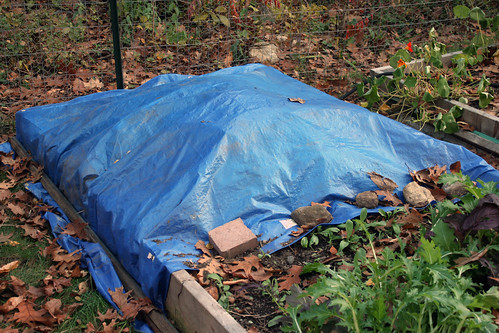
So, I put my tomato plants in a pile and cover them with a tarp in a sunny place. I should have done this a long time ago, but I figure better late then never. Next time, I will know what to do and will tarp infected plant material right away when I take it down.

This procedure should guarantee that the late blight pathogen is killed. The article doesn't say how long to tarp-treat teh plant material so I will leave it covered until spring and then compost it.

tarp to kill late blight IMG_0522

Monday, August 25, 2014

late blight hit my tomatoes

My curled leaved tomatoes have been hit a final blow, late blight. I picked all the red and green fruits and cut down the plants. I'll bag the infected plants soon and let them heat-kill in the sun for a few days before disposing in the trash.

I was able to harvest a good bucket of tomatoes to use for a few weeks. Here's hoping for a better tomato season next year!!

tomatoes_9431 tomatoes_9432

Saturday, May 17, 2014

tomato planting time!

What a great day! Perfect planting weather.

At my community garden today we distributed tomato seedlings that we raised at local greenhouse. Four varieties of late blight resistant tomatoes. About 350 plants distributed to 55 gardeners. Legend, Moutain Merit, Defiant and Jasper. Nice big seedlings.

It was a good day to be a gardener! Or a tomato seedling....

Thursday, July 11, 2013

late blight - arrgh!

I got a notice today that late blight appears to be in our area. Its within 200 miles away - in Franklin County, western MA. **#@&!!! *^&&%%*!!

Map: http://www.usablight.org/?q=map

At our community garden, we had such a bad experience with late blight last year that we contracted to have late blight resistant tomato seedlings grown for us by a local grower this spring. (I wish I could find the newspaper article link - another **%^$@!)

Our garden is supplying a few organic pest controls to all gardeners. Now that late blight is in the area, our recommendation is to spray all tomatoes and potatoes before rains and at least every 7 days alternating between Oxidate (Johnny's) and copper fungicide.

Tuesday, March 05, 2013

I signed up for an automatic alert when late blight is spotted within 200 miles of our Gardens. Here is the website http://usablight.org/alerts. There is no need to spray unless late blight spores are in the area - so this seems like a good system. Once I get a notification, I'm planning to spray with Copper fungicide (Bordeaux) alternating with Oxidate (Johnny's recommends this) every 7 to 10 days and before and after rains.

Friday, November 02, 2012

late blight resistant tomato seed

Does anyone have experience with late blight resistant tomatoes?

After all the problems we have had the past few years, we would like to provide our community gardeners with late blight resistant tomato seedlings next spring. I am looking into the best varieties.

I am thinking of trying these:
Defiant PhR (Johnny's Seed)
Mountain Magic (Johnny's Seed)
Plum Regal (Johnny's Seed)
Ferline (Thompson and Morgan)
Legend (Reimer Seeds)

Wednesday, August 08, 2012

late blight hit my tomatoes

late blight 042 late blight 035 late blight 031 Today I found definite late blight lesions on my tomatoes. Several of them. Even on fruit. Sad.

I removed all of the lesions and bagged them in plastic. I will leave the bag out in the sun for a few days to heat kill the pathogen, then I'll dispose of it in my home trash.

I also removed all of the larger tomatoes that seemed close to ripening. I'll rinse them and let them ripen at home.

I've been spraying with copper fungicide, so today after removing infected leaves, I sprayed the plants again. I suspect the blight will expand this week and expect I will be pulling the plants early next week. Sad.

The good side is I did get a nice harvest. I had a really super Purple Calabash plant this year. And I'll have more room for my fall seedlings.

Next year, I'm doing resistant varieties.

Wednesday, August 01, 2012

trying to prevent late blight

On Saturday, I found what looked like late blight in tomatoes in our community garden. I have been watching for it since it was confirmed a week ago in a field a mile away. I sent a sample for analysis (to UMass plant lab) and late blight was confirmed on Monday. Since then, its amazing how fast the infection has spread. Five plots now have nearly dead tomatoes and gardeners are in the process of removing the plants and debris. Adjacent plots have early infections.

My plot is on the far side of the garden from the start of the infection. Today, was another dreary wet afternoon. Perfect for spread of the fungus. I read that covering with plastic can protect the plants. I have been spraying with copper fungicide for two weeks, but thought it would be good to experiment with another method too. I haven't had such nice looking tomato plants in a long time and would love to have them produce into September.

So, today Skippy and I went to my plot and I put up a bit of a frame with some old wood poles lashed together with string. I spread a sheet of plastic over this and secured it with string. It covers the top and about 2-3 feet down on the side, but leaves plenty of room for airflow from below. I'm thinking the idea is to reduce the number of spores that can fall on the top of the plants. Also, keep the plants dry in all this rain we are having. While traveling in Switzerland, I saw that many home gardens had plastic coverings over their tomato plants. tomatoes under plastic 038

Its an experiment for me, just to see what happens. It will make it harder to get good coverage with the spray, but I am planning to spray again tomorrow.

It rained yet again just as I finished putting up the plastic. Underneath the tomatoes are dry. This seems to be good. I am really curious to hear if anyone has experience with tomatoes under plastic.

tomatoes under plastic 041 tomatoes under plastic 120 tomatoes under plastic 138 tomatoes under plastic 140

Wednesday, July 25, 2012

late blight

I just got back from spraying my tomato plants. We had a little rain yesterday and I've been spraying with a copper fungicide after every rain to protect against late blight. My plants look really good this year, so I'm hoping for a good harvest before the blight comes in.

The latest info on tomato blight is at this site: http://extension.umass.edu/vegetable/alerts/late-blight-alert-update

Late blight was spotted early this year, July 3, in some commercial tomato fields near my garden and in other parts of the New England. But it seems that it isn't spreading very rapidly.

A couple weeks ago, I sent out this notice to gardeners in our Community Garden.
Gardeners,

Bad news – On July 3, Late Blight was confirmed on tomato plants near us (Middlesex County MA). This is a very aggressive pathogen that can kill an entire field of tomatoes or potatoes within a few days.

As you may remember, we had a terrible year at the Belmont Victory Gardens with Late Blight in 2009. It affected the whole garden and the entire NE region with devastating effects for commercial growers.

We would like to ask you to do the following:
-    Please read some of the links and information on the bulletin board (we will post photos and info soon) to learn about Late Blight and how to identify it.
-    Check your tomato and potato plants carefully for Late Blight and report it immediately to me if you find any (UMASS extension service like to follow locations of outbreaks and fellow gardeners will also like to know). If you find damage that looks like late blight it must be removed from the Gardens and disposed of at home in your trash. Do not compost it! Late Blight spreads very quickly and it is important to do what we can to contain spread of the pathogen.
-    To protect your plants from infection (especially important in shadier and low lying areas):
o    Remove leaves at the bottom of tomato plants to increase airflow
o    Increase airflow around potatoes and tomatoes by trimming nearby plants, removing weeds, removing vines from fences, and keeping the paths mowed
o    Spray tomatoes and potatoes before every rain with a fixed Copper fungicide spray that is organic approved.

I walked through the Belmont gardens today and checked tomatoes and potatoes in many plots. I did not see any Late Blight, but did not have time to check all gardens. Actually, I think the tomatoes and potatoes look really good this year. There is a bit of Septoria leaf spot around as usual, which is a less aggressive fungus that causes small brown spots and yellowing from the edges of the leaves on both tomatoes and potatoes, but not much.

In my garden, I removed the Septoria damaged tomato leaves and disposed of them in my trash at home. I will be spraying with a copper fungicide soon. This is available at Hillside Garden Center as a powder or spray. Geno recommends a spray combination of Rotenone (also organic) and copper that is available at Agway in Waltham.

Some helpful links:
http://extension.umass.edu/vegetable/alerts/late-blight-alert-update
http://seacoasteatlocal.org/2012/07/alert-late-blight-found-in-massachusetts/
http://extension.unh.edu/Agric/lateblight.htm
http://nysipm.cornell.edu/publications/blight/
http://www.longislandhort.cornell.edu/vegpath/photos/lateblight_tomato.htm (lots of good photos here to learn how to identify Late Blight)

Our Yahoo and Facebook sites and are good places for conversations and advice. Also feel free to email me.

Kathy
Coordinator, Belmont Victory Community Gardens

Friday, July 23, 2010

late blight alert

I was disappointed to hear that late blight has been spotted in Massachusetts (links below) this week. On Tuesday, it was found on tomatoes in a field in Hadley MA (Hampshire County, western MA). Tests are being done to figure out where it came from.

Its also been found this year in a garden in Maine, and on commercial potatoes in Wisconsin.

I have been looking at tomatoes and potatoes in our plots and have yet to see any late blight.

UMASS late blight site
Cornell late blight site.

Saturday, February 20, 2010

potato order placed

I meant to order these a few weeks ago, but didn't actually do it. Now the order is placed - the day after the discounts ended :( I'm excited about the varieties I found though. Three of the four show resistance to late blight!! I should have had these last year. I got only 4 orders - last year I got 5 and this was a bit too much.

Here are the Moose Tubers' catalog descriptions:

Irish Cobbler Early. Buff skin, white flesh. Slightly larger than a golf ball, great for roasting or mashing, with a smooth creamy texture. Legend has it that an Irish shoemaker in the northeastern United States selected this variety from plants he grew from an Early Rose seed ball. First cataloged in 1876. Even dug early, Cobblers will store throughout the season. Resistant to mild mosaic and immune to wart. Medium-sized plant has white-tipped lilac flowers.

All Blue Mid-season. Dark purple skin, purple flesh. Russian Blue is another name for this brilliantly loud specialty spud. Keeps its color when cooked, yields aplenty, and stores decently. Mildly resistant to late blight, hollow heart, second growth and shatter bruise. Susceptible to common scab, bacterial ring rot, and golden nematode. Vigorous plants with blue blossoms. LBR.

Butte Late. Medium russet skin, white flesh. For all you fungal watchdogs out there, here is another variety field-resistant to late blight. A fine russeted pattern details the bronzed skin of the mealy white-fleshed Butte. Versatile in the kitchen, try it baked, fried, smashed, hashed, or whatever. All winter long! Released in 1977 from Idaho. Also resistant to common scab, hollow heart, and net necrosis. Produces best with wide spacing (16–18''), fertile soil, and regular watering. LBR.

Green Mountain. Late. Buff skin, white flesh Largely displaced from commercial potato seed circulation, this variety is the number-one pick for blight resistance. An outstanding heirloom that’s also just right for baking; so dig them once and keep the oven on all winter long. Its nice appearance and great flavor don’t fade in storage. Somewhat liable to succumb to pest damage and viral diseases, but show resistance to fusarium storage rot, black leg, and verticillium wilt. LBR.

(LBR means late blight resistance.)

All are new varieties for me except Green Mountain, which I grew last year and loved. It has fantastic crisp pure white flesh and keeps great. Last year I grew a different Russet (Rio Grande) which was great, but picked Butte this year for the LBR. I've heard Irish Cobbler recommended for its flavor. And I really looking forward to the blue potatoes to perk things up!

Saturday, October 10, 2009

Gretta's late blight advice

At the Seed Swap last weekend, Gretta (a local farmer, Shared Harvest CSA) talked with us about Late Blight. Her advice is to compost or dig in the tomatoes but make sure you remove all potatoes. The potatoes are the potential for spreading spores next year. Late Blight can overwinter in live plants (i.e. the potato tubers).

- DON'T let ANY undug potatoes sprout next year.
- Plant low crops in your old potato bed, so you can see and remove any sprouts.
- Try to dig ALL your potatoes this fall. It can be very hard to find them all. Have a potato digging party.

Less important is what you do with the tomato debris. These will not provide a live plant source for overwintering spores. Options:

- Dig in the tomato debris, layer on manure or compost, and plant cover crop. Turn this under in the spring.
- Compost the tomato debris and use it next year.
- OK to leave the plants standing in place and clean up next spring, but you should be layering on compost/manure and planting cover crops, so it makes makes more sense to clean it now.

And one more thing: in an area that was heavily infected by Late Blight (like my community plot), it doesn't make sense to plant tomatoes or potatoes again next year. Try to plant somewhere else.

Here are sources for this advice:
UMASS extension Late Blight Management for Fall
Johnny's Late Blight information

Monday, September 28, 2009

late blight again - the topic that just won't go away

As I clean up for next year, the Late Blight topic is coming up again. To bag and dispose or to compost?

There are two different camps out there:

Composters:
HortBlog
Gardener's Corner (Interesting last comment here where they recommend leaving the tomato plants to overwinter in the field as is so they will self-sow.)

Disposers:
Maryland Cooperative Extension
Dave's Garden
Cornell University Extension

I hate the idea of bagging and disposing, but I am in this camp. It is impossible to predict what our winter weather will be and harder yet to predict the conditions in the compost pile. So best to do what we can to avoid worse blight worse next year.

It seems to me reasons to compost are:
- you garden in a heavily infected community garden where many gardens will not be cleared and hence there is little chance of reducing the number of spores AND you have a reason not to try improve the situation anyway
- you got minimal Late Blight very late (September) and live in a cold area and feel the risks are low compered with the effort to dispose
- you plan to just forgo tomatoes and potatoes for a few years anyway
- you plan to spray all sorts of chemicals next year
- you don't care about potential spread from your garden to a nearby Organic Farmer

Regarding the last point, I just read this story about Old Path Farm, Utica NY (and there are lots of stories like this around). Late blight is an extremely destructive disease.

I am looking forward to our Seed Swap Day this Saturday, when Gretta Anderson, a local farmer from Shared Harvest CSA, will come and speak. Her topic will be "Late Blight: Sharing the collective experience of local organic growers this summer".

And here is a question left today on an earlier post on this blog:
I thought that the problem with the blight this year was that it came so early. Don't NE gardens usually get blight every year, but much later in the season (like, now?) If that's true, then there is no reason to worry about the disposal of the blighted plants at this point. The whole reason for burying them earlier was so that the blight couldn't affect your neighbor's (or your other) plants at their peak moment of the season. I am not an expert, that's just what I thought was the case from everything I read. Is that right? September 28, 2009 2:29 PM

I answered: I don't know. I thought the reason for disposal reason was to reduce the spores around next year. I am going to start a new post on this topic. Thanks for the question. September 28, 2009 3:22 PM

Please leave your opinion. Hopefully this topic will be gone next year and we won't have to belabor it ad infinitum.

Friday, September 04, 2009

late blight on eggplants

blighted eggplant 2 blighted eggplant
blighted eggplant leaves blighted eggplant stem

Ugly pictures!

I don't think its very common to get late blight on eggplants. But it sure looks like Late Blight.

Late Blight mostly hits potatoes and tomatoes. I had a big patch of blighted potatoes that I cut down back in June (luckily the tubers are 90% fine). And then in July, I removed 13 of my 16 heirloom tomatoes, grown from seed I started way back in March :( These were badly infected with Late Blight.

I suppose this is what I get from leaving the last 3 tomato plants in the plot (San Marzano, Hillbilly and Purple Calabash). The tomato plants are big and healthy looking for the most part, but there are signs of blight. But about 25% of the tomatoes rot before ripening.

About 20% of my eggplants have rot. These go into the 'Blight Bag'. I don't know how I'll ever be able to pick it up - its very heavy an full!

About 20% of my peppers have it too. They look very much like the eggplants.

I'm seriously considering a Solanaceae-free plot next year. Ouch.

Tuesday, August 04, 2009

late blight continues to kill tomatoes

On yesterday's visit to my community plot I found late blight on all of my remaining tomato plants. My next chore will be to remove them all. Bag and dispose in the trash. I was hoping a few of my plants would have survived, but all have succumbed. 16 plants - 11 varieties that I babied since March.

I also had a sad note from the New Hampshire Farm that I distribute CSA shares for. Its a long but very interesting note so I'm posting most of it here. Very sad to think of all the lost crops for local farmers.

I'm nervously watching my little patch of 8 tomato plants tucked in next to my house. But, with fingers crossed, they look fine so far. I make sure not to go near it after being at the community garden. Looks like another day or two til the big tomatoes ripen.
Late Blight appeared on our farm last week. Thursday, in the cherry tomatoes, enough small lesions that we took out the entire planting immediately, with the hope of preventing spread to our main tomato and potato fields. With several advisors from UHN Agricultural Extension, we examined our main season tomatoes and potatoes, and found no sign of Late Blight on Thursday. But by this morning, I found blight lesions in various places in the tomato field, including on one ripening tomato.

The quick summary for you again: Late Blight is a fungus endemic to the southern U.S. that, in wet years, makes its way north to New England. This is usually in September or later, and affects a few potato and tomato fields after the main harvest is concluded. It is not harmful to humans, except in terms of crop loss. It's not normally (never before this season) a big deal for most NE farms. This year, it seems that a single nursery from the south distributed infected tomato seedlings to Wal Mart and Home Depot, among others, who sold those plants to home gardeners across the Northeast. Once these plants were planted outside, the fungus began spreading across our region, some three months ahead of the typical schedule and in time to do serious damage to the harvest of both gardeners and farmers alike. Weather conditions suited the Blight perfectly - cool and wet - and we haven't yet seen the long stretch of hot and dry that might put the Late Blight in check. This week may be the dry and warm we've all been hoping for, though it's probably too late for the tomatoes on our farm.

There is no organic control for this fungus once it appears, and conventional sprays have limited effectiveness as well. The organic copper fungicides that we have used over the past 6 weeks may have some preventative effect, but because they are washed off in every rain, this has been a challenge. With the blight on our farm, the only options are to burn, bury, or discard affected plants to try to slow the spread through our farm and to other growers.

So right now, we are facing limited choices and a mountain of work. The sunny weather will be on our side as we proceed. In the tomatoes, the cherries are already untrellised and tilled in. Because the main season crop looks beautiful and is just beginning to ripen, we're going to try pulling out infected plants one by one, as well as using our hand-held flame weeder to burn infected leaves. Honestly, we're not hopeful, particularly because other farmers who are further along with the blight aren't reporting great success with these "pruning" strategies. We'll try this approach for a few days. Of course, we have a whole farm to care for, so cannot let everything else go for a potential fool's errand in one crop (even one of the favorites).

Potatoes, we are thanking our lucky stars that we already have a reasonable crop underground - blight notwithstanding, it's been a great potato growing season. However, the Late Blight spores can quickly travel through the vines and rot the potatoes underground. We've decided to kill the potato vines, and enjoy the harvest that is already sized up. Up and down our valley, farmers are doing the same. Conventional farmers use an herbicide for vine kill, and it is certainly disconcerting to see dead potato fields all over in early August. As organic growers, we have a harder road to hoe, as we attempt to mechanically kill all of the vines without damaging the potato hills underneath. First, we've been mowing the field. Later today we'll go through with weedwackers (yes, that's 8 miles of weedwacking!). When that's all done, we'll sweep through with the crew and loppers, knocking back the last remaining living stubs. We're learning that there's no such thing as "overkill" when it come to late blight. We'll see a smaller yield, as some spuds would have continued to size up over the rest of the summer. And we're uncertain if we'll lose some storability with such early vine kill - the potatoes have to store underground for at least two weeks after the vines are dead, to set the skins for storage. We'll see. But plenty of mashed potatoes remain in our future this season!

Of course, we're disappointed about (likely) losing the tomatoes, as we know you are as well (why couldn't it be the turnip blight?!). The epidemic proportions beyond our farm, as well as the connections to large-scale, industrial agriculture, make the blow a bit harder to swallow (or not swallow, as the case will be). We are so deeply sad for many other farmers who are seeing serious financial losses due to the blight. We hope you understand that there is abolutely nothing that we can do to have this crop for you this season. I really, really, really wish we did (can you hear me stomping my feet now?). Of course, everyone knows, not just farmers, that hard work doesn't always lead linearly to good results. We are affirmed in our commitment to growing for you, through Community Supported Agriculture. We are grateful for your support and understanding.

Jenny and Bruce, Picadilly Farm LLC, Winchester, NH


And another quote added Wednesday, August 5. This from a CSA farmer in White River Junction VT, after blight landed on his farm last week:
"All this reminds me that while climate change is the big cloud hanging over the land, it's actually transportation that has done the serious damage to our ecosystems so far. (Both problems being manifestations of fossil fuel use.) We humans love to travel, and we love to move stuff all over the place for fun or profit or by necessity. This brings new species into contact with one another, often to the detriment of one or both. Most of the damage in VT/NH has been to our forests so far - chestnut, elm, butternut, and beech essentially gone, with ash, hemlock, and possible sugar maple in imminent peril. Agriculture is in less danger, primarily because everything we grow is not native to here anyway. Hopefully in this case, a nice cold winter will wipe out the blight and bring us a fresh start next year."

Sunday, July 26, 2009

Late blight notice

late blight sign

Here's a sign I'll post at our community gardens tomorrow as I remove my contaminated compost pile. Let me know if you have any revisions to suggest!

And, I'm still looking for a vegetable disease expert for a presentation at our community garden. If anyone knows anyone to suggest, please let me know. I think we could use a topic for a gardeners gathering. A use for our newly cleared entrance area. Coffee and donuts, stewed zucchini and fresh lettuce leaves. Ahhh. What fun.

Friday, July 24, 2009

blighted potatoes

blighted botatoes

I thought the potatoes I dug were fine, even though the plants were heavily hit with late blight. But after three weeks of storage, I have realized they're not fine. The fingerlings and Russets that were hardest hit and that I cut down and dug first are turning brown and rotting in their bags.

[Late blight produces] characteristic coppery-brown discoloration of the potato flesh under the skin.... Infection of potato tubers arises from spores that develop on foliage. Tubers exposed by soil cracking or erosion of hills may come in contact with spores washed down from infected leaves and stems by rainfall or irrigation. Tubers infected during the growing season may partially decay before harvest. Tuber infection may also occur at harvest when tubers contact living spores remaining on infected vines. Little if any tuber-to-tuber spread of late blight occurs during storage if tubers are kept under cool, well-ventilated conditions. Ohio State Univ Extension Fact Sheet on Late Blight

-------
And here's a very helpful comment Soilman left me a few days ago:

Hiya,
Blight is a pain, isn't it?
I've given up with tomatoes. I just can't bear seeing them struck down with blight every year. Potato blight, though, can be managed. I get it every year (it's a routine hazard in the UK climate), but I've never had a crop failure. The key is to remove all the haulms when the blight starts to really get hold.
You then wait at least 10 days before you dig the potatoes; without the haulm, the blight spores get fried in the sun. Choose a warm, dry day to harvest the potatoes. If they're thoroughly dried before storage, you should be OK. It's always worked for me. One crucial point: NEVER put potato haulms on the compost heap. Burn them.

-------
And here's a what the CSA farmer at Piccadilly Farm in southern New Hampshire wrote about late blight yesterday:

A note on the Late Blight front: farmers in all parts of New England are reporting serious losses in potatoes and tomatoes. The spread seems to be snowballing, and any prolonged cool, wet weather exacerbates the problem. We scout daily and have seen no sign of Late Blight here. The tomatoes look great and are beginning to size up. Every passing week means more spuds sizing up and less loss on that crop if we do get the blight here. I know I'll be counting down the weeks until the relief of that last potato harvest in October (12 weeks...)! Coupling this stress for vegetable growers with the devastating financial crisis that dairy producers are facing, many regional farmers are having a tough go of it.


sliced blighted potatoes

These rotting potatoes were dug right after I cut down the foliage, so I guess that was the error. I have lots of potatoes still in the ground now though I have cut down all of the foliage. Guess I'll just be patient for a few weeks before harvesting more.

And, someday I need to figure out how to dispose of my compost pile. Its full of blighted tomato and potato foliage. I don't think anything around here is dry enough to burn. Maybe a big deep hole? I don't know ... Can I just dump it in the woods?

Saturday, July 18, 2009

more on late blight

Late blight seem to be the only conversation topic I hear this week at our community gardens. I hear yelling from across the way about newly discovered dead tomato plants. I hear long technical discussions among groups of gardeners.

And everyone spends a fair amount of time walking around and looking at tomato and potato plants in other plots. People come by my plot to chat and they know whose plants look good and whose are dead. They remind me that I should be bagging and destroying the foliage so it doesn't infect everyone else's plants, which, of course are all already infected or dead or coated with fungicide.

And there are stories circulating about who has pulled everything, who won't pull anything, who's bagging and disposing, and, probably one about me just throwing my dead plants into my compost bin.

I heard someone dug up a whole row of potatoes that were just mush from blight.

I emailed the extension school yesterday to see if there any experts who could come talk to us. With so much interest, I think it would be a good way to get the gardeners together, though we can be an unruly bunch. We could have a nice relaxing coffee and donuts gathering, in a freshly mowed grassy area with beautiful mid summer flowers, singing birds, and listen to tomato gloom and doom stories....

An article on Late Blight is in yesterday's New York Times: "Outbreak of Fungus Threatens Tomato Crop" :
"A highly contagious fungus that destroys tomato plants has quickly spread to nearly every state in the Northeast and the mid-Atlantic, and the weather over the next week may determine ... whether tomato crops are ruined.... described as an “explosive” rate of infection.....William Fry, a professor of plant pathology at Cornell, said, “I’ve never seen this on such a wide scale.”

"The current outbreak is believed to have spread from plants in garden stores to backyard gardens and commercial fields.... Some growers are talking about $40 boxes already."

Some facts I've learned about late blight:
- Lat Blight was responsible for the Irish potato famine of the mid-19th century.
- It is one of the few plant diseases that can destroy an entire crop.
- The disease can wipe out entire tomato and potato fields within a week if conditions are wet.
- Late blight spores can travel over 40 miles under the right conditions.
- Powerful synthetic fungicides like chlorothalonil (not approved for organic farming) can protect unaffected plants from disease, but can't cure infected ones.
- Copper fungicides are officially listed as synthetics but organic certified farmers are allowed to use these after they have used all available alternative practices to manage late blight.
- Copper fungicides extend potato growing period by between 2-4 weeks.... estimated to result in 10 - 40% higher yields.
- Potato varieties with moderate levels of resistance include: Kennebec, Sebago, Allegany, and Rosa. Elba is currently the most resistant potato variety available.
- Few late blight resistant tomato varieties are available. The cultivar 'Legend' has some resistance, though not under high disease pressure. Some cherry tomato cultivars ('Red Cherry' and 'Sweetie') are more tolerant to late blight. 'Matt's Wild Cherry' is considered resistant.
- If late blight occurs when potatoes tubers have already 'sized up', harvest crop as soon as possible to avoid post-harvest tuber rot.
- Tubers become infected when spores wash down through the soil and come into contact with the potatoes. Tubers are not infected via their connection to plants with blighted foliage.
- Occasionally peppers and eggplants are mildly infected, as are a few nightshade weeds.

Fungicides for late blight on potatoes
Cornell University fact sheet on Late Blight
Tuesday, July 14, 2009

potatoes, potatoes

harvest

On Sunday, a week after cutting down most of my badly blight damaged (Late Blight) potato plants, I found more blight damage. Actually all my varieties now show a lot of blight spots. But the earlier varieties are worse off. The Russet foliage (a late variety) is nice and green still, but leaves have lots of brown/moldy looking spots. The Red Gold (early variety) plants were yellowed falling over and with brown/moldy leaf spots. Its normal for the plants to die back, and I don't know how much the blight has affected this timing.

I cut off all foliage from the Red Golds and left the Russets and Green Mountain for now. Then we harvested a single plant of Red Gold. I was really pleased with the tubers! A dozen pretty red potatoes, the smallest were golf ball sized, 2 lbs total weight.

We also harvested all of the fingerlings that had volunteered in my paths. A total of 4 lbs of nice small potatoes. How exciting. And its nice to have open paths again.

There was no sign of any blight damage to the tubers. I will wait to harvest more since leaving them in the ground at least two weeks is supposed to kill the blight spores in the living plant material. Plus the potatoes keep fine underground, better than in my kitchen. I'll harvest as I need them. Or when I want to replant the bed.

And then, last-of-all, I got out the yellow spray bottle of Copper soap and heavily sprayed all the foliage of the potatoes and tomatoes. Maybe that will help the Russets get a bit bigger.

fingerlings and red gold harvest cleaned up potato bed
freshly racked path

Here are photos of the Late Blight damage on the potato foliage:
late blight on potato foliage IMG_9417
Late Blight on Russet foliage Late Blight on Russet foliage

potatoes (Solanum tuberosum)
late blight (Phytophthora infestans)

Friday, July 10, 2009

fighting late blight - organic copper spray

CuS

Well, today I bought a bottle of copper sulfate spray (Concern copper soap fungicide). My dad says this is the only organic remedy for Late Blight. I'm planning to use this on my tomato and potato plants at my plot tomorrow.

My dad's friend Tom, a serious gardener, uses mancozeb in regular applications on his tomatoes starting in early spring. He says the only problem with using copper sulfate against Late Blight is that it doesn't work. Hmmm. But mancozeb is a pretty serious chemical.

My potatoes don't seem to be too badly off. A bit of leaf damage here and there. I'm gradually removing the plants and so far the tubers are great.

But Late Blight has already killed half of my 16 tomato plants (11 different heirloom varieties grown from seeds at home started on March 21st). Unlike last year's fungus in my garden, Septoria Leaf Spot, which gradually defoliated my plants, Late Blight this year has gotten into the stems of my tomato plants.

This is what Late Blight looks like on my tomatoes. This is what it looks like on my potatoes.

I suspect that gardeners with nice looking tomatoes right now in our community plots are using mancozeb or a similar chemical fungicide.

Its just hard to fight fungi when the weather is so wet. (And I hear that Late Blight infected seedlings were distributed by chain retailers in the NE, like Home Depot and Walmart.)

In a community plot, these fungi are spread all over by the wind. My tomatoes at home are looking beautiful, isolated from other gardens by many houses and yards. Maybe serious chemicals are the only way to go in a community plot? After a second bad year, it seems like a consideration for next year. Alternatively I could forgo tomatoes in my plot.

If you have Late Blight symptoms, it's recommended that you remove affected plants, bag them in plastic and dispose in the trash (or bury at least 2 feet deep). Pretty serious methods if you need to cart several big bags out of your plot. And this only works if EVERYONE in the community garden also does this. If not, everyone should either forget the tomatoes next year or all get some chemical fungicide.

I'd sure love to hear your comments!

In any case, I'll be spraying away with my copper sulfate tomorrow....

potatoes (Solanum tuberosum)
late blight (Phytophthora infestans)