Showing posts with label garden diagrams. Show all posts

Friday, January 02, 2015

plans for another year

I drew up a couple diagrams for this year's gardens.
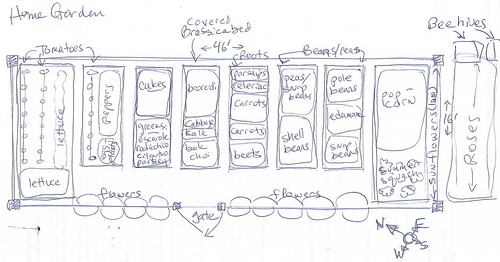
home garden plan 2015 In planning for a new year, I always move everything so nothing grows in the same location as last last year (crop rotation).

Along with rotation, I want to do a few things different this year. For my home garden:

- I've moved the tomatoes to a bed that didn't have the store bought compost that made them sick last year. Last year, all my tomatoes had spindly growth, curled leaves, and very few tomatoes. I hope the move will help.

- I'll add some flowers along the front fence. I thought I'd be adding a raised bed there eventually, but not enough room. I think flowers right in the soil will look nice.

- This year, I'd like to have more broccoli, carrots, beets and shell beans. I don't think I had too much of anything last year. Maybe a few too many eggplants, snow peas and snap beans. I made more space for this year by removing the zinnias patch from the garden.
community plot plan 2015
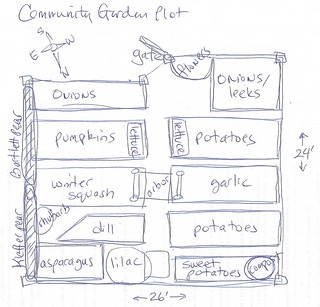
Again this year, my community plot will grow crops that need less regular care. I was able to tend this plot once a week last year and it worked out well. Changes for my community plot include:

- Growing flowers up the arbor rather than winter squash. Last year, I ended up with too much squash.

- Moving the dill out of the onion beds and into its own bed. The dill self sows and its easy to leave it where it comes up. But I think my onions will do better with more sun.

- I'm growing a lot less sweet potatoes this year. I didn't get a very good harvest last year. I had lots of very small tubers. I'll allocate a small space to the sweets for a while and see if I can get them to grow better. Maybe its just a matter of spacing the plants further apart, maybe I need new varieties.

Wednesday, March 12, 2014

companion planting plans

home garden diagram 2014 v5 I've looked up some companion planting suggestions and included the on my planting diagram. I'll put carrots next to parsley. Peas away from cucumbers. Lupines next to the peas. Marigolds and Bee Balm with the tomatoes. And lettuce by the squash. I've never done more than the basic companion planting - add marigolds and pollinator-attracting flowers here and there. It'll be fun to give this a try.

I've grown hyssop for years and its great for attracting bees. I'll put a row of hyssop, lavender and Echinacea along the front to attract pollinators and look pretty.

At my community plot, I'll also try a bit of companion planting this year. Tansy with the squash and pansies with the onions.

community garden diagram 2014 v5

Sunday, February 10, 2013

2013 garden plans

Garden plan 2013
While snowed in, I worked on my Garden Plan for the coming season. Its just a guide for me, and I don't follow it to the letter. The most important parts of the Plan are making sure the locations of the potatoes and roots are rotated. Also, reminding me that there is a limit to the amount of space I have and I shouldn't go too crazy with planting seeds.

A couple things I plan to do differently this year:
- Move the cucumbers to a bed of their own so they don't over run the eggplants.
- Grow only half as many Butternut squash, 5 plants instead of 10.
- Try shell beans (Jacob's Cattle and Cannelloni), since beans do OK in my shadier plots.
- Grow more carrots, beets, and onions.
- Grow a row of heirloom tomatoes in my sunniest spot at home (in my cold frame), and a row of late-blight resistant tomatoes at my community plot.
- Don't plant basil under the tomatoes again in case I want to spray the tomatoes. (I lost my basil last year.) Probably nothing should be under the tomatoes.
- Save more seeds. I want to pick 2 or 3 of my favorite crops and begin saving their seeds.

Saturday, April 07, 2012

2012 garden plan

garden plan 2012

I've cut back on a few things this year, no popcorn, no melons. Only 3 pumpkin plants. Only 12 tomato plants. I'm going to try my tomatoes scattered in different locations in the garden rather than all in one patch hoping this will reduce fungi problems I've had the last few years.

In the center of my plan is a new feature currently under construction, a new garden arbor. I'm planning to grow squash up one side and flowers up the other. It is a good solid wood arbor that can hold the weight of butternut, which are always very productive in this plot.

Wednesday, May 11, 2011

oak leaves and garden plans

oak leaves 012

Its an old saying I remember reading: "Plant corn when the oak leaves are a big as squirrels ears." My guess is this weekend will be perfect timing for planting corn.

A couple months ago my son asked me to plant popcorn again this year. I had decided I didn't have enough room and hadn't set aside space for popcorn. But I'm not one to refuse a gardening request. So I revised my plan (below) to make room for corn.

In addition to the added popcorn, when I went to prepare the bed for the potatoes as planned, I can across two giant underground rocks that I couldn't move. So the potato bed had to be moved too. Here is the revised plan. We'll see how well I follow this.

Microsoft PowerPoint - Garden plan 2011b

Thursday, January 06, 2011

2011 garden plan

Microsoft PowerPoint - Garden plan 2011

I think this will be a good plan for my two vegetable garden plots for the coming year.

Wednesday, April 21, 2010

white house vegetable garden

white house south lawn with vegetable garden
white house vegetable garden

I was in Washington DC for a business conference (AACR) this week and had one tourist location I made sure to find time for: the White House Vegetable Garden! I wasn't able to get a tour, but did peek through the fence and take photos.

It seems to be planted nicely already. What do you think is in? I think I see onions, and broccoli. The poles are maybe for a pea trellis? Maybe rhubarb in the raised beds at the left? Probably salad greens too. There is a big stack of beehives about 50 feet from the garden, by the tree in the middle of the lawn. Looks great!

I added a diagram below of the garden last year and a link to a nice news article about the garden.

me by the white house vegetable garden white house vegetable garden through the trees
white house vegetable garden information plaque


This year's White House vegetable garden is 1500 square feet (about 26 by 60 feet). That's a bit bigger than my vegetable garden space of about 1000 square feet: community plot (25 x 30) and my home garden (a 10 x 12 bed and five 10 x 3.5 beds). This amount of space can produce a ton of food - even with a amateur gardener. The link below says the White House garden produced 1000 pounds of food last year. I'm sure they could put a small farm on the lawn, but I think the point is to have a family garden. This is a perfect scale for a family.

The article also says Michelle expanded the garden this year. "The newly planted garden is 400 square feet larger than last year and will contain four new vegetables: bok choy, cauliflower, artichokes, and mustard greens."

April 1, 2010, The Christian Science Monitor, Michelle Obama expands the White House garden,

Sunday, November 01, 2009

a FANTASTIC book: Designing the New Kitchen Garden by J Bartley


I'm really enjoying reading this book. Every word. Its wonderful.

Who would have thought a book on designing the New Kitchen Garden would start way back with medieval gardens? And that garden history would be so fascinating? The drawings of courtyard gardens are detailed and beautiful. Jennifer Bartley is a wonderfully creative and inspiring writer.

I'm enjoying the lists of plants grown in different types of gardens. Medicinals and herbals from monastery plots. Always ready for new (and old!) ideas for next year's garden, I'm imagining an officinalis section with borage, hyssop, lavender, lemon balm and rosemary.

I love the lessons Bartley brings - "that our garden would be a source of pleasure and healing to those that visit us." And the gardener of course. The possibility of balancing spirit, soul and body by nurturing an oasis that provides beauty, a haven of restfulness and fresh authentic food. Of the garden as a "workshop". Of the potager not as a plot hidden in the corner of the backyard, but as a central feature, an all-season landscape. Herbs, vegetable and flowers even in the front yard of the most exclusive neighborhood.

Bartley's photos are beautiful: rhubarb grown to blanch in tall willow baskets with nasturtiums trailing over the edges. Old espaliered fruit trees next to young rows of greens. Companions, structures, plans and lists. I may read this five or six times. It is a rich and full book for gardening at many levels. Outlined guidelines, garden principles, plants list and diagrams. A true inspiration for the new potager.

Designing the New Kitchen Garden: An American Potager Handbook by Jennifer Bartley


Thanks to Timber Books for sending me a free copy of this book for review.

Tuesday, October 20, 2009

2010 planning

Microsoft PowerPoint - crop rotation plans

I'm starting the planning process early this year. I want to figure out where the garlic should be planted and where I need manure/compost. My gardens have gotten too big to enrich all beds, so I'm looking into crop rotation plans.

The general strategy is to rotate crops that use a lot of nutrients with those that use low levels and those that generate nutrients. The diagram below shows the strategy. Most crops I plant use heavy amounts of nutrients. Crops like tomatoes and squashes. I'll need to add manure/compost to these beds. But at least its not all of my beds.

Another thing I wanted to figure out is moving all Late Blight susceptible crops (all solanacea) out of my community plot and into my home garden for next year. This seems to work out fine. All tomatoes, potatoes, eggplants and peppers will fit fine at home.

I looked up companion planting information and added a few flowers and herbs that are beneficial.

Tomorrow I plan to have some time for gardening - and the weather should be nice. I'd like to finish planting garlic. Also bring a few loads of compost/manure to my community plot and seed all beds with winter rye. The home plots need more clean up, and then compost and rye seeding. The season is winding down fast.

crop rotation plans

Tuesday, March 24, 2009

work on the white house garden


I came across the White House blog with a diagram of the new vegetable garden. Looks really nice. Lots of lettuce. And I was looking at the photos of Michele gardening. My goodness, I have to do something about my gardening wardrobe! What is she wearing? I love it, but now I feel way under dressed....

Sunday, October 12, 2008

plot plan to scale

Microsoft PowerPoint - Vegetable garden plan 2009b

A revised plan for next year with the scale corrected. Nice to have more space than I realized. I added in an asparagus patch and moved my garlic from home to plot.

My home garden exposure is part sun at the west side (sun from 11-3 pm) and part shade (sun from 1-4 at the east side. My community plot gets full sun.

garden planning (drawings and diagrams)

Wednesday, September 24, 2008

rough draft for next year

Microsoft PowerPoint - Vegetable garden plan 2009a

This is a quick early plan for next year's garden - to give us an idea of where to put the rocks for the bench. The new space we are adding is to the east of my gate in the community plot.

garden planning (drawings and diagrams)

Sunday, April 20, 2008

garden plan

garden plan
Here's a drawing of my current plan for my community garden plot. (It's almost legible - my writing is not the best.) I've changed from rows to beds. I'm going to experiment with companion planting this year, so I hope to mix in herbs or flowers with many of my crops.

Sally Cunningham the author of Great Garden Companions recommends tansy with beets. I have some nice tansy sprouts from winter sowing. What do you think about putting this aggressive (and pretty) plant in my plot? Tansy may repel potato beetles and squash but more importantly and it attracts a broad range beneficial insects.

gardenplan
garden planning (drawings and diagrams)

Tuesday, March 13, 2007

more planning

plan20001
I've been doing another revision of my 2007 garden planting diagram. I wanted to make sure I make room for all of the seeds I've mail-ordered this year. I also wanted to take into account the amount of sunlight different areas receive. We have a large tree to the east of the garden and a small tree to the west. As a result, only beds at the center of the garden get full sunlight. I am adding new space against the house, which will get full sunlight and, I expect, will also be warmer with the radiant heat from the south-facing wall.

I've found a couple of nice websites with information about plants' sunlight requirements: Growing Vegetables in the Shade and Ten Vegetables You Can Grow In Shade.

In general in this diagram, the colored blocks indicate plants that need full sun and lots of warmth. These are the fruiting vegetables, like tomatoes, eggplant, peppers, squash, cukes and beans. The green shaded blocks are the leaf and root vegetables that are OK with less sunlight, like lettuce, beets and carrots. I have bought lots of different greens seeds this year, like endive, chard, many lettuce varieties, kale, etc. I will seed these every 2 or 3 weeks all through the year as they were a great crop last year. I want to make sure I leave enough space for them, but not too much.

So here it is - another, and probably the final, revision of MY PLAN. The soil has almost thawed and I hope planting will start soon.

Wednesday, January 17, 2007

garden plan


This is my plan for this year's vegetable garden. I think I'll increase my space by removing a large rhododendron and a yew that are growing in an area against the house with full sunlight. Like my seed order, I'll probably revise this plan several times. Then who knows if I'll really follow it. But it does give me some sense of how many seeds to buy.

S&P

garden planning (drawings and diagrams)